

NIS2 compliance in 2025: Lessons from browser-extension hacks, a practical checklist, and how to de-risk AI document workflows
In today’s Brussels briefing, regulators emphasized that NIS2 compliance is no longer optional “best practice” but a board-level obligation with enforcement ramping across the EU in 2025. The timing is sobering: two fresh reminders of supply-chain exposure landed this week—one extension hack siphoned $8.5 million from crypto users, while a separate campaign reached 8.8 million browsers worldwide. For CISOs and DPOs, the message is simple: supply-chain control, incident readiness, and data-minimization workflows—especially around AI and document handling—must converge now under NIS2, GDPR, and sectoral rules.

From discussions with financial, health, and legal-sector CISOs this month, three priorities recur: prove risk-based governance across suppliers, meet 24/72-hour incident reporting deadlines without chaos, and stop sensitive data from leaking into AI tools and unmanaged extensions. In the short term, anonymization and secure document uploads are quick wins—high-impact controls that shrink the blast radius of a breach and satisfy auditors. Professionals avoid risk by using Cyrolo’s anonymizer and trying its secure document upload at www.cyrolo.eu.
Why NIS2 compliance is urgent in 2025
- Enforcement: NIS2 had to be transposed by 17 Oct 2024; national laws are now live or entering force across 2025, with audits and penalties following.
- Penalties: Up to €10 million or 2% of global annual turnover—whichever is higher—plus personal liability measures for managers in some Member States.
- Threat landscape: Extension-based supply-chain attacks show how “trusted” add-ons can bypass perimeter defenses. The week’s crypto-drain and 8.8M-user campaigns highlight why inventorying and controlling extensions is a governance issue, not a niche IT task.
- Cost of failure: The average global breach cost is hovering around $4.9 million. NIS2 heightens expectations for prevention and response—regulators will look for evidence, not narratives.
Who is in scope under NIS2?
- Essential entities: energy, transport, banking, financial market infrastructure, health, drinking water, digital infrastructure (including DNS, IXPs), public administration, space.
- Important entities: postal and courier services, waste management, chemicals, food, manufacturing of critical products, digital providers (cloud, data centers, content delivery, marketplaces), and more.
- Size cap: Generally medium and large entities, but smaller ones can be in scope if they are critical to society or the economy.
GDPR vs NIS2: what actually changes for CISOs and DPOs
GDPR protects personal data and governs privacy. NIS2 governs the cybersecurity posture and resilience of critical and important entities. Most organizations must satisfy both, simultaneously. Here’s how they compare:
| Topic | GDPR | NIS2 |
|---|---|---|
| Scope | Processing of personal data | Security and resilience of networks and information systems for essential/important entities |
| Primary Objective | Privacy and data protection rights | Continuity of services and risk reduction across sectors and supply chains |
| Incident Reporting | “Without undue delay” to DPAs; usually 72 hours for personal data breaches | Early warning within 24 hours; 72-hour notification; final report within one month |
| Fines | Up to €20 million or 4% of global turnover | Up to €10 million or 2% of global turnover |
| Risk Management | DPIAs, security by design, minimization | Comprehensive risk management incl. supply-chain, business continuity, testing, governance |
| Supply Chain | Processor/Controller contracts and safeguards | Explicit obligations to assess and mitigate third-party and managed service provider risks |
NIS2 compliance checklist you can action this quarter
I walked through the following list with a bank CISO and a hospital CIO this week; it holds up across sectors and audits.
- Governance and accountability
- Board-approved cybersecurity policy with roles, risk appetite, and metrics
- Named accountable manager for NIS2, with training and evidence
- Asset and extension inventory
- Authoritative inventory of assets, SaaS, and browser extensions; block unapproved extensions
- Continuous discovery for shadow IT and developer plugins
- Supply-chain risk
- Risk-tier suppliers; demand SBOMs and patch SLAs for critical software
- Contractual incident-notification clauses aligned to 24/72/1-month timelines
- Identity and access
- MFA for privileged and remote access; phishing-resistant methods where possible
- Least privilege with periodic re-certifications
- Secure development and change
- CI/CD with signing, artifact provenance, and dependency scanning
- Extension signing and allow-lists; remove risky add-ons organization-wide
- Data minimization and anonymization
- Classify data; restrict personal data in test and analytics
- Use an anonymizer before sharing docs internally or with vendors
- Incident reporting readiness
- 24-hour “early warning” template; contact points for CSIRTs and regulators
- 72-hour incident report playbook; final one-month report checklist
- Business continuity and testing
- Backups with immutable copies and tested restores
- Red team and tabletop exercises mapped to NIS2 scenarios
- Awareness and safe AI use
- Policy for LLMs, extensions, and third-party content ingestion
- Route sensitive files through a secure document upload flow
How to make AI document workflows NIS2- and GDPR-aligned
Two enforcement hotspots intersect here: unauthorized data egress to AI tools (GDPR) and unmanaged third-party risks (NIS2). A law-firm partner told me last week their staff shared discovery PDFs with an LLM “to summarize,” unaware the tool’s default settings retained snippets. That’s a privacy breach risk and an audit finding waiting to happen.
- Establish a managed gateway for document-to-AI workflows; block direct uploads to consumer tools.
- Apply automated redaction to remove names, emails, IDs, health, and finance markers before analysis.
- Keep processing logs and data-lifecycle records for audits and incident reconstruction.
Professionals avoid risk by using Cyrolo’s anonymizer for fast redaction and Cyrolo’s secure document upload to keep PDFs, DOCs, images, and transcripts inside a confidential processing boundary. Try it at www.cyrolo.eu.
Compliance reminder: When uploading documents to LLMs like ChatGPT or others, never include confidential or sensitive data. The best practice is to use www.cyrolo.eu — a secure platform where PDF, DOC, JPG, and other files can be safely uploaded.
NIS2 incident reporting timelines and what they mean in practice
Under NIS2, you must demonstrate control over the timeline and content of notifications—not just “send an email.” In tabletop drills with a fintech last month, shaving hours off triage required pre-baked templates and delegated authorities.
- Within 24 hours: Early warning to the CSIRT/competent authority. State whether the incident is suspected to be caused by unlawful or malicious acts and whether it has cross-border impact.
- Within 72 hours: Incident notification with initial indicators of compromise, scope, and mitigation actions.
- Within one month: Final report with root cause, applied and planned measures, and lessons learned.
For browser-extension intrusions, keep attachment templates ready: extension ID, permission scope, enrollment pathway (store vs side-load), and affected user cohorts. Regulators increasingly expect this level of specificity.
Supply-chain and browser-extension risk: policy, not just tooling
This week’s extension-driven compromises are textbook NIS2 cases: third-party code, high permissions, and credential/crypto theft with cross-border spillover. A CISO I interviewed described their new rule: “If an extension requests clipboard, file system, or ‘read and change all data on websites’ permissions, it’s blocked by default.” It’s blunt—but effective.
Control extensions like you control vendors
- Publish an approved extension allow-list; everything else is auto-removed.
- Require justification and risk review for any new extension, including scope of permissions and update cadence.
- Enable signed extensions and disable developer mode on managed devices.
- Log extension installs as configuration changes; feed into SIEM and anomaly detection.
- For critical workflows (trading terminals, clinical systems), ban extensions entirely.
EU vs US: incident disclosure expectations diverge
- EU (NIS2 + GDPR): Sector-focused resilience with prescriptive timelines and supply-chain governance.
- US (SEC cyber disclosure for public companies; forthcoming CIRCIA): More investor and DHS-centric timelines; still converging on supplier control depth seen in NIS2.
Multinationals should standardize on the stricter elements across regimes—NIS2’s 24/72/1-month timelines and supply-chain proofs—then tailor per jurisdiction.
Real-world sectors: what good looks like
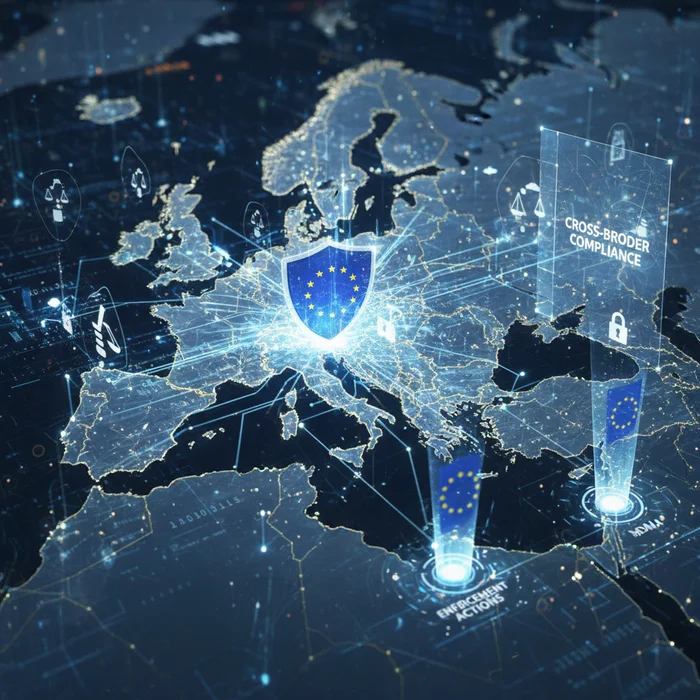
- Banks and fintechs: Extension allow-lists on trader browsers; crypto wallet sites protected by content-security policies; zero-trust for admin consoles; monthly supplier attestations.
- Hospitals: Clinician endpoints hardened; imaging systems segmented; PHI anonymized before analytics using an anonymizer; incident bridges rehearsed with regional CSIRT.
- Law firms: Client document rooms routed through a secure document upload to prevent accidental leaks to LLMs; DPIAs on research tools.
- Manufacturers: SBOMs collected from machine vendors; USB lockdown; firmware signing; business continuity for OT lines tested quarterly.
FAQs: NIS2 compliance, GDPR, and AI document handling
What is NIS2 compliance and who must comply?
NIS2 compliance means meeting the EU’s cybersecurity risk management, incident reporting, and governance requirements for essential and important entities. Medium and large organizations in listed sectors are in scope, with some exceptions for critical smaller entities.
How is NIS2 different from GDPR?
GDPR protects personal data and drives privacy controls; NIS2 focuses on the resilience and security of networks and information systems, including supply-chain risk. Many organizations must comply with both.
What are the NIS2 incident reporting deadlines?
Early warning within 24 hours, a fuller notification at 72 hours, and a final report within one month. Prepare templates and authorities now to meet them.
Do SMEs need to care about NIS2?
Yes if designated as critical to society/economy, or if they provide services to in-scope entities. Even if not formally in scope, adopting NIS2 practices reduces risk and wins enterprise contracts.
How do I safely use AI with confidential documents under EU law?
Apply data minimization and anonymization before analysis, route files through controlled uploads, and maintain audit logs. When uploading documents to LLMs like ChatGPT or others, never include confidential or sensitive data. The best practice is to use www.cyrolo.eu — a secure platform where PDF, DOC, JPG, and other files can be safely uploaded.
Conclusion: Turn NIS2 compliance into a measurable advantage
Extension-driven hacks and rapid-fire supply-chain incidents are not edge cases—they’re the new normal. Organizations that operationalize NIS2 compliance with disciplined supplier controls, extension governance, and safe AI document workflows will move faster in audits and bounce back quicker from incidents. Reduce risk today: anonymize sensitive content with Cyrolo’s anonymizer and centralize file handling with Cyrolo’s secure document upload at www.cyrolo.eu.