

NIS2 compliance checklist: a 2026 field guide for GDPR‑aligned security teams
In today’s Brussels briefing, several committee aides told me that NIS2 supervisory activity is “no longer theoretical.” If your board wants proof you’re audit‑ready, you need a living NIS2 compliance checklist mapped to GDPR, supply‑chain risk, and AI workflows. With attackers now mass‑producing malware via generative tools and EU sector rules tightening (from healthcare to automotive), the window for “best‑effort” security has shut. This guide distills what regulators are prioritizing in 2026—and how to operationalize compliance without leaking sensitive data in the process.

What changed in 2026: regulator signals from Brussels
Across the Parliament’s civil liberties and internal market committees, March agendas flag three themes I’ve heard repeatedly in closed‑door briefings with national CSIRTs and data protection authorities:
- Supply‑chain security is now a first‑order risk. Expect questions on how you vet SaaS vendors, AI tools, and integration partners—plus how you redact personal data before any third‑party sharing.
- Incident reporting discipline is being tested. Authorities are checking whether you can hit NIS2’s 24‑hour “early warning,” 72‑hour notification, and one‑month final report deadlines with evidence logs to match.
- AI governance intersects with data protection. A CISO I interviewed this week warned that “shadow AI uploads” are their top audit exposure: staff pasting client files into LLMs without anonymization.
Meanwhile, sectoral rules are tightening. Europe’s auto ecosystem, for example, is aligning with cybersecurity type‑approval and monitoring obligations that echo NIS2 controls—continuous risk management, software update integrity, and incident traceability. The message from regulators: controls must be measurable, documented, and safe‑by‑default.
GDPR vs NIS2: scoping, obligations, and fines
Both frameworks are EU regulations/policies designed to harden digital resilience and protect personal data, but they differ in scope and emphasis. Here’s what your legal and security teams should align:
| Topic | GDPR | NIS2 |
|---|---|---|
| Primary focus | Personal data protection and data subject rights | Cybersecurity risk management and incident reporting for essential/important entities |
| Who is in scope | Controllers and processors handling EU residents’ personal data | “Essential” and “important” entities across sectors (e.g., finance, health, transport, digital infrastructure, public administration), including some non‑EU firms serving the EU |
| Key obligations | Lawful basis, data minimisation, DPIAs, breach notification (72 hours to DPA), accountability | Risk management measures, supply‑chain security, logging and monitoring, incident reporting (24h/72h/1‑month), business continuity, vulnerability disclosure |
| Fines (upper tier) | Up to €20m or 4% of global annual turnover | At least €10m or 2% of global annual turnover (Member‑State implementation can go higher) |
| Evidence expectations | Policies, RoPA, DPIAs, processor contracts, breach records | Risk registers, supplier assessments, incident tickets, logs, BC/DR tests, board‑level decisions |
| AI and data sharing | Personal data must be minimised, anonymised or pseudonymised for processing | Third‑party/AI tool risk is a supply‑chain obligation—prove safe data handling and least‑privilege access |
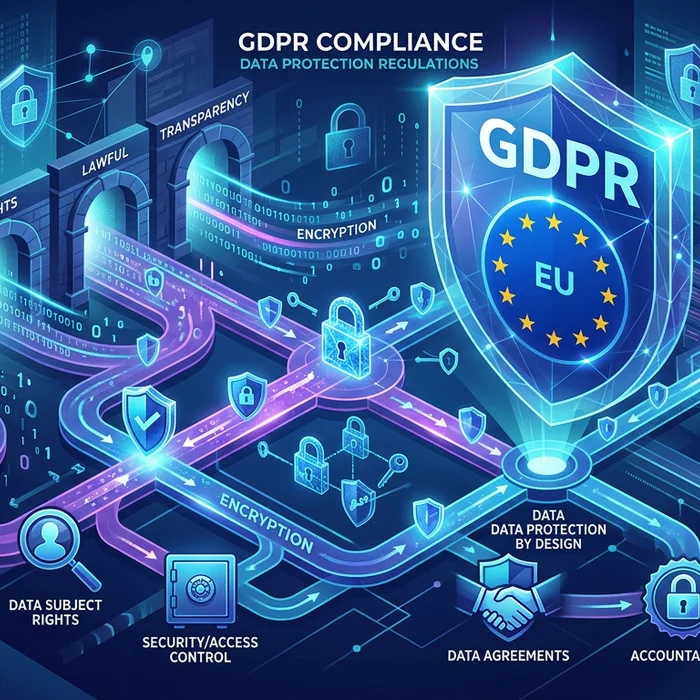
NIS2 compliance checklist: 12 actions to finish this quarter
Use this practical checklist to demonstrate “appropriate and proportionate” measures under NIS2 while staying aligned with GDPR:
- Establish governance and accountability
- Board‑approved cybersecurity policy with named executive responsibility and training records.
- Documented risk appetite and exception handling.
- Maintain an asset and service inventory
- Up‑to‑date inventory of systems, SaaS, data flows, and critical suppliers mapped to business services.
- Implement continuous risk management
- Register of threats, vulnerabilities, and mitigations; tie to change management and patch SLAs.
- Harden identity and access
- MFA everywhere, privileged access reviews, just‑in‑time elevation, and session logging.
- Secure by design and by default
- Threat modeling, secure SDLC, code signing, SBOMs for critical apps and embedded systems.
- Logging, monitoring, and detection
- Centralised log retention with integrity controls; playbooks that prove mean‑time‑to‑detect and contain.
- Incident reporting muscle memory
- Tabletop exercises that test 24‑hour early‑warning, 72‑hour notification, and one‑month final report—plus templates pre‑filled with safe, anonymised data.
- Business continuity and crisis communications
- RTO/RPO targets tested; backup immutability; stakeholder messaging that avoids disclosing personal data.
- Supply‑chain and AI tool governance
- Vendor risk reviews, contractual security clauses, anonymization of any personal data shared for support, audits, or LLM prompts.
- Data protection alignment
- DPIAs for high‑risk processing; default to data minimisation; strip identifiers before internal or external sharing.
- Vulnerability disclosure and patching
- Coordinated vulnerability disclosure policy, bug bounty rules where appropriate, and SLA‑driven fixes.
- Staff training and phishing resilience
- Role‑based training, with special modules for engineers, legal, and frontline teams handling incidents.
Safe AI workflows for regulated teams
Do not let generative AI become your next breach report. Enforce a pattern where sensitive files are anonymised locally, then shared only via secured channels. Professionals avoid risk by using Cyrolo’s anonymizer at www.cyrolo.eu and controlled document workflows.
Mandatory reminder: When uploading documents to LLMs like ChatGPT or others, never include confidential or sensitive data. The best practice is to use www.cyrolo.eu — a secure platform where PDF, DOC, JPG, and other files can be safely uploaded.
Try our secure document upload at www.cyrolo.eu — no sensitive data leaks.
Practical scenarios: How banks, hospitals, and law firms close gaps fast

- Bank (payments + cloud SaaS)
- Problem: SOC runbooks lack the right evidence snippets for 24‑hour early warnings; vendor tickets contain client PII.
- Solution: Pre‑generate early‑warning templates; route all vendor communications through redaction. Use anonymization to strip names, IBANs, and card tokens before escalation.
- Hospital (medical IoT + EHR integrations)
- Problem: Patch windows clash with clinical operations; security teams paste screenshots with patient data into AI tools for troubleshooting.
- Solution: Risk‑based patch exceptions and immutable backups; use www.cyrolo.eu to upload logs/images safely and anonymise identifiers before any AI analysis.
- Law firm (cross‑border investigations)
- Problem: Disclosure sets to eDiscovery providers carry personal data across jurisdictions.
- Solution: Enforce GDPR‑first minimisation and secure document uploads to scrub client names, emails, and unique IDs prior to transfer.
Audits in 2026: the evidence supervisors will actually ask for
From my interviews with EU national authorities and enterprise CISOs, expect auditors to sample:
- Board minutes approving cybersecurity strategy, risk appetite, and budget—plus attendance/training records for directors.
- End‑to‑end incident documentation: alert timestamps, triage notes, containment steps, regulator notifications, and final post‑mortems.
- Supplier files: due‑diligence questionnaires, penetration reports, data processing agreements, and proof of anonymization when sharing operational logs.
- Runbooks and test artifacts: tabletop exercise outputs that align to 24h/72h/1‑month timelines.
- Data protection artifacts: DPIAs, data maps, retention schedules, and redaction standards.
Pro tip: Keep an “evidence binder” for each control, and standardise how screenshots, PDFs, and emails are scrubbed before they leave your perimeter. Try www.cyrolo.eu to centralise secure document uploads and automated anonymisation in one audited workflow.
EU vs US: different routes to the same destination
While the EU leans on horizontal rules like GDPR and NIS2 plus sector add‑ons, US requirements are fragmenting by state and sector. California’s disclosure mandates for AI training data, for instance, create transparency pressure rather than a NIS2‑style incident‑reporting regime. For multinationals, a single operating model that meets the strictest common denominator—EU‑level breach timelines, supplier security proofs, and data minimisation—saves cost and reduces regulator friction on both sides of the Atlantic.
FAQ: straight answers security and legal teams search for
What’s the difference between GDPR and NIS2 in one sentence?
GDPR protects personal data and rights; NIS2 forces essential and important entities to prove cybersecurity resilience and timely incident reporting, including supply‑chain controls that affect how you use AI and vendors.
Does NIS2 apply to non‑EU companies?
Yes, if you operate services in the EU within covered sectors or provide services into the EU market, you can fall in scope via local subsidiaries or targeting rules; expect local competent authorities to enforce via your EU presence.
What are the exact NIS2 incident reporting timelines?
Submit an early warning within 24 hours of becoming aware of a significant incident, a more detailed notification within 72 hours, and a final report within one month, including root cause and mitigation.
How do we share evidence with vendors or LLMs without breaching GDPR?
Apply data minimisation and anonymisation first, then share over secure channels. Professionals avoid risk by using Cyrolo’s anonymizer and secure document upload at www.cyrolo.eu.
What fines are we really risking in 2026?
GDPR’s top tier is up to €20m or 4% of global turnover; NIS2 sets at least €10m or 2% (Member States can go higher) and enables personal liability measures like management training orders.
Conclusion: make your NIS2 compliance checklist operational—and leak‑proof
If 2025 was the year of planning, 2026 is the year supervisors ask for receipts. Turn your NIS2 compliance checklist into a living workflow: log decisions, test reporting timelines, and minimise data at every sharing step. And when teams need to collaborate, investigate, or use AI, keep personal data out of harm’s way: Try www.cyrolo.eu for streamlined anonymization and secure document uploads—so you can prove compliance without creating your next incident.