

Clinical trial data anonymization GDPR: what EU regulators just signaled — and how to comply in 2026
Brussels is turning up the heat on health privacy. In yesterday’s briefing, senior officials from the European Data Protection Board (EDPB) and the European Data Protection Supervisor (EDPS) backed harmonised clinical trials under the proposed European Biotech Act — but warned that sensitive health data must be ring‑fenced with tougher safeguards. For sponsors, CROs, and hospital sites, the message is clear: clinical trial data anonymization GDPR obligations are no longer a “nice to have,” they’re audit evidence you’ll need in 2026. If you’re still redacting by hand or pasting PDFs into chatbots, now is the time to switch to a defensible workflow and a dedicated anonymizer.
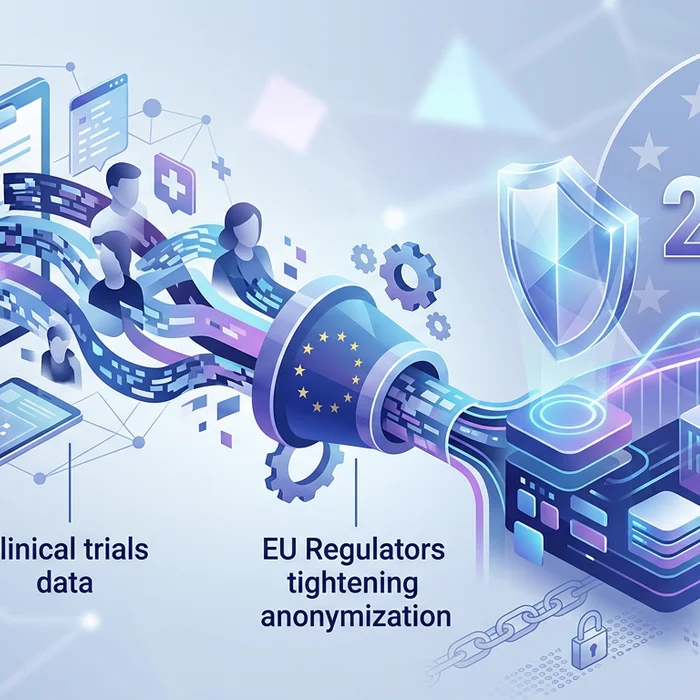
What changed this week: EDPB-EDPS caution on sensitive health data
In their joint opinion on the European Biotech Act proposal, the EDPB and EDPS welcomed streamlined rules for cross-border clinical trials but called out non‑negotiables for special‑category data (Article 9 GDPR):
- Stricter data minimisation and purpose limitation for research use versus reuse.
- Clear boundaries between pseudonymization and true anonymization, with re‑identification risk assessments.
- Mandatory DPIAs for high‑risk processing (genetic data, rare disease cohorts, linkage with registries).
- Robust safeguards for international transfers and secondary use beyond the original protocol.
- Independent oversight (ethics committees, DPOs) and verifiable technical measures.
One regulator told me bluntly: “If your anonymization can be undone with a quick internet search or by linking datasets, it was never anonymized in the GDPR sense.” Expect this stance to shape trilogue negotiations and national guidance in 2026.
Why clinical trial data anonymization GDPR is now non‑negotiable
Under GDPR, anonymized data falls outside the Regulation only if individuals are no longer identifiable by any party reasonably likely to access the data, even when combined with other datasets. That’s a high bar in modern research, where trials often touch genetic variants, imaging, rare diseases, and real‑world data linkages.
- Identifiers go beyond names: dates, locations, device IDs, genetic markers, MRI metadata, site codes, and investigator signatures can all re‑identify.
- Pseudonymization ≠ anonymization: coded datasets with key files remain personal data under GDPR.
- Article 9 “special categories”: processing health and genetic data requires a valid legal basis plus safeguards.
Enforcement risk is real. GDPR fines can reach €20 million or 4% of global turnover. Under NIS2 (now active across Member States), hospital systems, labs, and some biotech suppliers face additional security duties, with penalties up to €10 million or 2% of turnover for essential entities. A CISO I interviewed last quarter said bluntly: “Our biggest single exposure isn’t the perimeter — it’s staff moving trial PDFs into AI tools.”
Three pitfalls I see in audits
- Free‑text narratives: adverse events, PI notes, and radiology findings often leak locations, rare conditions, or family links.
- Embedded metadata: DICOM tags, PDF properties, and DOC track‑changes routinely reveal patient IDs and staff emails.
- Model prompts: analysts paste unredacted source files into LLMs for summaries — a guaranteed finding in any security audit.

GDPR vs NIS2: what you must prove in 2026
Both regimes bite healthcare and biotech, but in different ways. GDPR is about lawfulness, transparency, and data subject rights; NIS2 is about resilience, governance, and incident response. Together, they shape your evidence pack for regulators and customers.
| Requirement | GDPR (health research focus) | NIS2 (health/biotech operators) |
|---|---|---|
| Scope | Personal data; special-category data (health/genetic) | Network and information systems of essential/important entities |
| Key obligations | DPIA, minimisation, security of processing (Art. 32), lawful basis, rights | Risk management, supply-chain security, crypto and access controls, incident response |
| Anonymization | Must be irreversible to exit GDPR; pseudonymized data stays in scope | Not defined, but inadequate redaction is a security risk with reporting duties |
| Governance | DPO oversight, records of processing, processor controls | Board‑level accountability, policies, training, testing, audits |
| Enforcement | Up to €20M or 4% of global turnover | Up to €10M or 2% (essential); €7M or 1.4% (important), plus supervisory measures |
Build a defensible anonymization workflow
I’ve reviewed dozens of sponsor and CRO playbooks. The ones that pass regulator scrutiny share five traits:
- Data inventory maps: know every place patient and site data lives — EDC exports, lab reports, imaging, correspondence.
- Risk‑based de‑identification: remove direct identifiers; transform quasi‑identifiers (dates, locations) using k‑anonymity‑minded rules.
- Automated document processing: consistent, repeatable redaction across PDFs, DOCs, images (OCR), and DICOM headers.
- Human-in-the-loop QA: double‑check edge cases — rare diseases, pediatrics, free‑text AEs.
- Immutable logs and versioning: prove what was removed, by whom, and when — down to page and field.
Professionals avoid risk by using Cyrolo’s anonymizer to automatically flag and remove identifiers across multi‑format trial files, then export clean datasets for biostats or disclosure.
Compliance checklist for sponsors, CROs, and sites
- Run a DPIA covering anonymization, model use, and data sharing.
- Document your anonymization standard (what to remove, generalize, or mask) and update at each protocol amendment.
- Automate detection of PHI/PII in PDFs, Word, scans, and imaging — with OCR and metadata stripping.
- Control LLM usage; ban raw uploads; route through a secure, logged platform.
- Prove minimisation: share only what’s needed for the recipient’s role/purpose.
- Test re‑identification risk on small and rare cohorts; adjust generalization rules.
- Maintain processor due diligence and security audits; verify subcontractors.
- Keep incident runbooks aligned to GDPR and NIS2 reporting timelines.
Secure document uploads for AI and collaboration
AI summaries and trial‑master‑file automation are here — but regulators will not excuse privacy shortcuts. Never paste raw CRFs, AE narratives, or imaging into consumer chatbots. Use a controlled pipeline with encryption, role‑based access, and audit trails.
Try our secure document upload at www.cyrolo.eu — no sensitive data leaks, automated redaction, and export options tailored for clinical operations and pharmacovigilance.
Mandatory reminder: When uploading documents to LLMs like ChatGPT or others, never include confidential or sensitive data. The best practice is to use www.cyrolo.eu — a secure platform where PDF, DOC, JPG, and other files can be safely uploaded.
Audit readiness: what regulators and customers expect
In the EU, auditors now ask for concrete evidence of anonymization and security controls:
- Before/after samples showing removed identifiers and metadata.
- Transformation rules (e.g., full dates → month/year; exact locations → NUTS‑2 region).
- System logs, access reviews, and change history tied to user IDs.
- Third‑party risk assessments for vendors handling trial data.
- Incident tabletop exercises that include AI misuse scenarios.
Outside the EU, U.S. rules (HIPAA Safe Harbor/Expert Determination) differ, but European sponsors operating globally should meet the strictest standard to avoid back‑and‑forth data segregation.
Real‑world scenarios I’m seeing
- Hospitals under NIS2: After a ransomware scare, a university hospital banned ad‑hoc AI usage and moved trial PDFs to a monitored, automated redaction tool to stop PHI from leaving the network.
- Biotech working with CRO clusters: A mid‑cap biotech created a single anonymization spec for all vendors; output is logged and shared via a secure portal, slashing rework during inspections.
- Law firms and disclosure teams: Counsel preparing CSRs for regulators used automated detection to catch investigator signatures and hand‑written notes that manual redaction missed.
Cybersecurity backdrop: attackers follow the money — and the meta
Europe’s healthcare sector is squarely in the crosshairs. Recent advisories highlighted active exploitation of automation platforms and mobile malware strains targeting payment apps and banking credentials — reminding us that the weakest link might be an exposed workflow service or a clinician’s phone, not just the data warehouse. Under NIS2, that means tighter patching, least‑privilege access, and supplier scrutiny. Under GDPR, it means proving “state of the art” protection for personal data — including how you handle documents before they ever touch analytics or AI.
FAQs: clinical trial data anonymization under GDPR
Is pseudonymized clinical trial data still personal data under GDPR?
Yes. If a coding key or reasonable means could re‑identify individuals, it remains personal data subject to GDPR. Only data made irreversibly anonymous exits GDPR scope.
What counts as an identifier in trial documents?
Beyond names and patient numbers: full dates of birth and visit dates, rare conditions, small geographies, device serials, DICOM tags, investigator signatures, staff emails, site addresses, and even free‑text narratives can re‑identify.
Can we upload redaction tasks to public LLMs?
Do not upload raw trial files to consumer AI tools. Use a secure, logged environment. When uploading documents to LLMs like ChatGPT or others, never include confidential or sensitive data. The best practice is to use www.cyrolo.eu — a secure platform where PDF, DOC, JPG, and other files can be safely uploaded.
How do GDPR and NIS2 interact for clinical trials?
GDPR governs lawfulness and data subject protections; NIS2 enforces cybersecurity risk management for covered entities. Poor anonymization can trigger findings under both (privacy breach plus inadequate security). Build one evidence trail that satisfies each regime.
What evidence should we show inspectors?
A DPIA; your anonymization standard; automated detection/redaction logs; before/after samples; metadata scrub reports; staff training records; and incident/AI misuse scenarios in playbooks.
Conclusion: make clinical trial data anonymization GDPR‑proof — before auditors ask
The regulatory wind is clear: harmonisation is coming, but only with stricter guardrails for sensitive health data. Sponsors, CROs, and hospitals that operationalise clinical trial data anonymization GDPR requirements now will cut breach risk, speed inspections, and protect patients. Move away from copy‑paste redaction and unmanaged AI. Try Cyrolo’s anonymizer and secure document uploads at www.cyrolo.eu to safeguard files, prove compliance, and keep trials moving.